
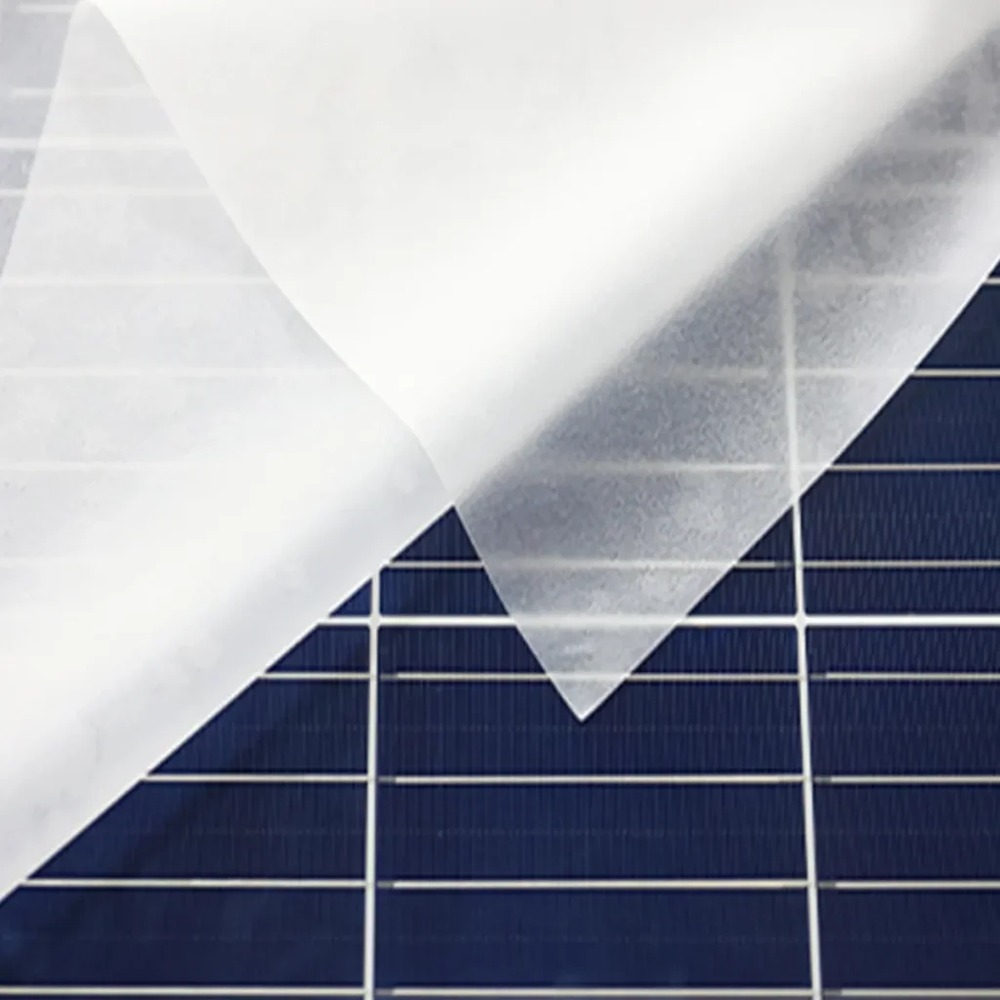
What EVA film contributes to a laminated glass assembly.
A laminated glass pane is two or more glass sheets joined by a plastic interlayer. When the interlayer is EVA film, the sheets are assembled with the film between them and passed through a controlled heat and pressure cycle. The film softens, wets the glass surfaces and then sets, leaving a single transparent laminate. The interlayer is the element that turns separate panes into one structural and optical unit.
Adhesion is the first function. A well-bonded interlayer prevents the glass sheets from moving independently and keeps the assembly transparent rather than showing a visible gap. Clarity follows from the same condition: the film and glass must make intimate contact so that light passes through the stack without scattering at an interface. Surface cleanliness during lay-up therefore matters as much as the film itself.
Safety behaviour is the third function. If a pane is broken, the fragments remain attached to the interlayer instead of separating. This is why laminated glass is specified for overhead glazing, balustrades, facades and transport applications. The film holds the broken pieces in place and retains a barrier even after the glass has cracked.
Film is cut to the glass dimensions and placed in a clean lay-up. Edges are aligned before the assembly enters the lamination cycle. Heat and pressure are applied for a supplier-defined period, after which the pane is cooled and inspected. Edge quality and the absence of trapped air are the usual visual checks. Deviations in the lay-up tend to show up as haze, bubbles or edge lift. The same attention is needed at the edges, where a small gap can become a visible line in the finished pane.
EVA interlayer film is one route among several. The comparison article EVA film versus PVB interlayer sets out the differences, while the laminated glass application page lists the film role and process steps. Product details are on the EVA film page.
Laminated glazing relies on the interlayer to bond and retain the panes.
Related reading: EVA film in PDLC smart glass.
Product and application pages connected to this topic.
More reading from our news center.
Reach our sales contact directly for EVA film selection and product questions.
Julie Gong
Bouling Chemical Co., Limited
Email, call or message our sales contact directly. We reply to product and application questions.
Scan to chat with Julie Gong on WhatsApp.


